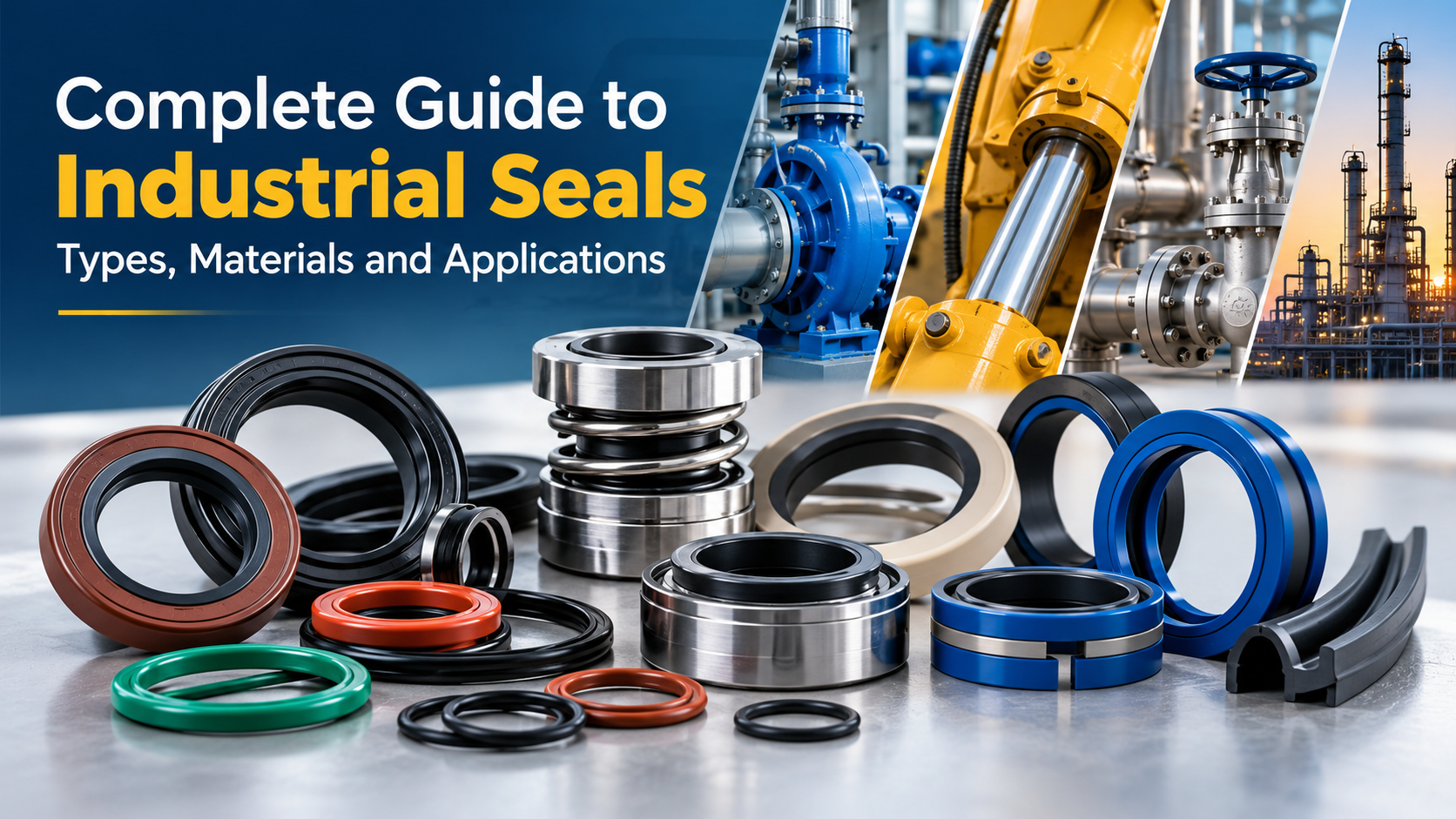
Industrial seals are essential components used across almost every sector where machinery, fluids, gases, pressure, or moving parts are involved. From hydraulic cylinders and pumps to compressors, gearboxes, valves, and heavy industrial equipment, seals help prevent leakage, protect components from contamination, and maintain the efficiency and reliability of machinery.
Choosing the right industrial seal is not simply a matter of selecting a size that fits. The seal material, operating temperature, pressure, fluid compatibility, movement, shaft speed, surface condition, and application environment all influence seal performance and service life.
This guide explains the major types of industrial seals, commonly used sealing materials, their applications, and the key factors to consider when selecting the right seal.
What Are Industrial Seals?
Industrial seals are components designed to prevent unwanted movement of fluids or gases between two surfaces or to prevent contaminants from entering machinery.
Depending on the application, a seal may be used between stationary components or between components that move relative to each other. Some seals are designed for hydraulic pressure, while others are optimized for rotating shafts, high temperatures, aggressive chemicals, or demanding industrial environments.
A properly selected seal can help:
- Prevent oil, water, hydraulic fluid, and other media from leaking
- Keep dust, dirt, moisture, and other contaminants outside equipment
- Maintain pressure inside hydraulic and pneumatic systems
- Reduce friction between moving components
- Protect bearings, shafts, cylinders, and other machinery components
- Improve equipment reliability and operating efficiency
- Reduce maintenance requirements and unplanned downtime
Because industrial equipment operates under very different conditions, there is no single seal type or material suitable for every application.
Why Are Industrial Seals Important?
Even a relatively small seal can have a major effect on the performance of industrial machinery.
A failed seal can result in fluid leakage, pressure loss, contamination, increased friction, equipment damage, and production downtime. In some applications, leakage can also create safety, environmental, or product-quality concerns.
For example, a damaged hydraulic cylinder seal can allow hydraulic fluid to escape and reduce cylinder performance. Similarly, a failed oil seal in a gearbox can cause lubricant loss and eventually contribute to premature bearing or gear failure.
For this reason, industrial seals should be treated as critical engineering components rather than simple replacement parts.
Major Types of Industrial Seals
Industrial seals are available in many different designs. The appropriate type depends on the equipment and operating conditions.
1. O-Rings
O-rings are one of the most widely used sealing components in industrial equipment. They have a circular cross-section and are typically installed in a groove between two mating surfaces.
O-rings can be used for both static and certain dynamic sealing applications. They are commonly found in hydraulic equipment, pneumatic systems, pumps, valves, machinery, and pipe connections.
Their popularity comes from their simple design, relatively low cost, and availability in a wide range of materials and sizes.
The correct O-ring material must be selected based on factors such as temperature, pressure, and chemical compatibility.
2. Oil Seals
Oil seals, also known as rotary shaft seals or radial shaft seals, are commonly used around rotating shafts.
Their primary purpose is to retain lubricants such as oil or grease while preventing external contaminants from entering the equipment.
Oil seals are frequently used in:
- Gearboxes
- Electric motors
- Pumps
- Engines
- Industrial machinery
- Agricultural equipment
- Automotive and transportation equipment
Different lip designs and materials are available depending on the application.
3. Hydraulic Seals
Hydraulic seals are designed specifically for hydraulic systems where components operate under pressure.
They are commonly used in hydraulic cylinders and other hydraulic equipment to prevent hydraulic fluid from escaping and to maintain system pressure.
Common hydraulic seal types include:
- Rod seals
- Piston seals
- Wiper seals
- Guide rings
- Buffer seals
- V-seals
- Static seals
Hydraulic seal selection depends on pressure, temperature, cylinder speed, fluid type, and the type of movement involved.
4. Pneumatic Seals
Pneumatic seals are used in systems powered by compressed air. They are commonly found in pneumatic cylinders, valves, actuators, and automation equipment.
Unlike many hydraulic applications, pneumatic systems generally operate at lower pressures but can involve high operating speeds. Therefore, friction, wear resistance, and low breakaway force are important considerations.
5. Mechanical Seals
Mechanical seals are commonly used to prevent fluid leakage around rotating shafts, particularly in pumps and rotating equipment.
A mechanical seal generally consists of carefully engineered sealing faces that operate against each other. Depending on the design, additional components such as springs, secondary seals, and metal parts are included.
Mechanical seals are widely used in:
- Centrifugal pumps
- Chemical processing equipment
- Water treatment systems
- Industrial mixers
- Agitators
- Process equipment
- Oil and gas equipment
Mechanical seals are available in different configurations, including single and double mechanical seals, cartridge seals, and component seals.
6. Wiper Seals
Wiper seals, sometimes called scraper seals, are primarily designed to prevent dirt, dust, moisture, and other contaminants from entering hydraulic or pneumatic equipment.
They are commonly installed on the external side of hydraulic cylinders.
A wiper seal is especially important in construction, mining, agricultural, and other environments where machinery is exposed to dirt and abrasive contaminants.
7. V-Seals
V-seals are flexible rubber sealing elements commonly used for rotating shafts. They are designed to provide axial sealing while rotating with the shaft.
They can be used to retain grease or other lubricants and help protect components from dust and moisture.
Common Industrial Seal Materials
Selecting the correct material is just as important as selecting the correct seal design.
Different elastomers and engineered materials provide different levels of resistance to temperature, chemicals, pressure, abrasion, and wear.
NBR — Nitrile Rubber
NBR is one of the most commonly used elastomers for industrial sealing applications.
It provides good resistance to petroleum-based oils and fuels and offers a useful combination of mechanical strength, wear resistance, and cost-effectiveness.
NBR is commonly used for:
- Oil seals
- O-rings
- Hydraulic seals
- Pneumatic seals
- General industrial applications
However, NBR may not be the best choice for applications involving certain chemicals, ozone exposure, or extremely high temperatures.
FKM
FKM is a high-performance elastomer known for its resistance to elevated temperatures, oils, fuels, and many chemicals.
It is frequently selected for demanding industrial applications where standard elastomers may not provide adequate performance.
Typical applications include:
- Oil and gas equipment
- Chemical processing
- High-temperature machinery
- Automotive systems
- Pumps and valves
EPDM
EPDM provides excellent resistance to water, steam, weathering, ozone, and many environmental conditions.
It is commonly used in applications involving water, hot water, steam, and certain chemicals.
However, EPDM is generally not suitable for applications involving petroleum-based oils and fuels.
PTFE
PTFE is an engineered polymer with excellent chemical resistance and a wide operating temperature range.
It also offers low friction, making it useful in demanding sealing applications.
PTFE seals can be found in:
- Chemical processing equipment
- Hydraulic systems
- Pumps
- Valves
- High-temperature applications
- Specialized industrial equipment
Polyurethane (PU)
Polyurethane is known for its excellent abrasion resistance, mechanical strength, and flexibility.
It is widely used for hydraulic and pneumatic sealing applications, particularly where wear resistance is important.
Industrial Seal Applications
Industrial seals are used across a wide range of industries and equipment.
Pumps
Pumps rely on seals to prevent fluid leakage around shafts, housings, and connections. Mechanical seals and other sealing solutions are commonly used depending on the pump design and fluid being handled.
Hydraulic Cylinders
Hydraulic cylinders use several types of seals, including piston seals, rod seals, wiper seals, and static seals.
These seals work together to maintain hydraulic pressure and prevent fluid leakage.
Gearboxes
Gearboxes require effective sealing to retain lubricants and prevent contaminants from entering. Oil seals are commonly used around rotating shafts.
Compressors
Compressors can operate under demanding pressure and temperature conditions. Seal selection must take into account the gas or fluid being handled, operating pressure, temperature, and shaft movement.
Valves
Valves may use O-rings, stem seals, packing, or other sealing technologies depending on the valve design and application.
Oil and Gas Equipment
Oil and gas equipment often operates under high pressure, temperature, and chemically demanding conditions. Seal materials and designs therefore need to be selected carefully for the specific operating environment.
Chemical Processing
Chemical processing equipment requires seals that can withstand aggressive chemicals without excessive swelling, degradation, or loss of mechanical properties.
Food and Beverage Equipment
Seals used in food and beverage processing equipment may need to meet specific hygiene, temperature, and material requirements depending on the application and applicable standards.
Construction and Mining Equipment
Construction and mining machinery operates in environments where dust, dirt, water, vibration, high loads, and abrasion can be significant concerns.
Hydraulic seals, wiper seals, and other heavy-duty sealing solutions are widely used in this sector.
How to Choose the Right Industrial Seal
Selecting an industrial seal should begin with understanding the operating conditions rather than simply matching dimensions.
Consider the following factors:
1. Operating Temperature
Determine the minimum and maximum temperatures the seal will experience.
A material that performs well at room temperature may deteriorate or lose its properties when exposed to extreme heat or cold.
2. Operating Pressure
Pressure has a major influence on seal performance.
High-pressure hydraulic applications may require specialized seal profiles and materials designed to resist extrusion and deformation.
3. Fluid or Media Compatibility
Identify exactly what the seal will come into contact with.
This may include:
- Hydraulic oil
- Mineral oil
- Water
- Steam
- Fuel
- Chemicals
- Compressed air
- Process fluids
Material compatibility should always be checked before selecting a seal.
4. Type of Movement
Determine whether the seal will be exposed to:
- Static conditions
- Reciprocating movement
- Rotary movement
- Oscillating movement
A seal designed for a static application may not perform correctly in a high-speed rotating application.
5. Speed
For rotating and reciprocating applications, movement speed can affect friction, heat generation, and wear.
6. Dimensions
Correct dimensions are essential.
Depending on the seal type, important measurements may include:
- Shaft diameter
- Bore diameter
- Housing diameter
- Groove dimensions
- Seal cross-section
- Installation space
7. Surface Condition
Shaft roughness, hardness, scratches, corrosion, and runout can significantly influence seal life.
Even a high-quality seal may fail prematurely if the mating surface is damaged or unsuitable.
8. Environmental Conditions
Consider whether the equipment operates in an environment involving:
- Dust
- Water
- Humidity
- Chemicals
- UV exposure
- Extreme temperatures
- Abrasive particles
The surrounding environment can influence both seal material and seal design.
Common Causes of Industrial Seal Failure
Seal failure does not always mean that the seal itself was defective.
Common causes include:
- Incorrect seal selection
- Wrong material
- Incorrect dimensions
- Excessive pressure
- Excessive temperature
- Improper installation
- Shaft damage
- Incorrect surface finish
- Misalignment
- Excessive vibration
- Chemical incompatibility
- Contamination
- Excessive speed
- Insufficient lubrication
Identifying the actual cause of failure before installing a replacement is important. Simply replacing a failed seal without addressing the underlying problem may result in another premature failure.
How to Extend Industrial Seal Service Life
Several practices can help improve seal performance and reduce unexpected failures.
First, select the seal based on the complete operating environment rather than price or dimensions alone.
Second, inspect shafts, grooves, housings, and mating surfaces before installation. Damaged surfaces can quickly damage a new seal.
Third, follow appropriate installation procedures and avoid cutting, twisting, stretching, or damaging the seal during installation.
Finally, maintain equipment properly and monitor signs of leakage, abnormal friction, overheating, or contamination.
Why Work With a Reliable Industrial Seal Supplier?
Industrial sealing requirements can vary considerably between applications. A reliable supplier should be able to help identify the appropriate seal type, material, dimensions, and configuration based on the equipment and operating conditions.
For replacement requirements, providing as much information as possible—such as the existing seal dimensions, equipment type, operating pressure, temperature, fluid, speed, and application—can make the identification process faster and more accurate.
For customized or specialized requirements, technical consultation can also help determine whether a standard seal or application-specific solution is more appropriate.
Conclusion
Industrial seals play a critical role in maintaining the performance, reliability, and efficiency of modern machinery. From O-rings and oil seals to hydraulic seals and mechanical seals, each type is designed for particular operating conditions and applications.
The right choice depends on more than size. Temperature, pressure, fluid compatibility, movement, speed, surface condition, environmental exposure, and material properties should all be considered when selecting an industrial seal.
Whether you need seals for hydraulic cylinders, pumps, gearboxes, valves, compressors, process equipment, or other industrial machinery, selecting the correct sealing solution can help reduce leakage, minimize downtime, and improve equipment reliability.
Seals Center Qatar supplies and manufactures industrial sealing solutions for a wide range of industrial applications. If you need assistance identifying the right seal for your equipment or require a specific industrial sealing solution, contact our team with your application details and requirements.